Gamified Wellbeing vs. Traditional Wellness Programs
The data is clear, Team and leaders are not engaging with wellness apps, and they're not using these tools. So this raises a real question for buyers: if usage is this low, what exactly is your user report showing?
With the current data and practices, we can see that access to wellbeing is not the problem, the problem is usage. And in the real world, it's not just usage of the apps, it's that teams and users do not feel engaged and do not see any effect.
The data shows companies do invest in sponsored wellness programs, yet average participation is only 30 to 35 percent. The result is obvious: the company's investment gets wasted, organizational engagement falls, and this comes back as lower organizational performance and workplace burnout.
The data is clear, employees are not engaging, and they're not using these tools. So this raises a real question for buyers: if usage is this low, what exactly is your user report showing?
As buyers, you have the right to ask this question, because this data is real, and you deserve wellbeing programs that use approaches which guarantee engagement and provide clear, transparent data. That's what gamified wellbeing is.
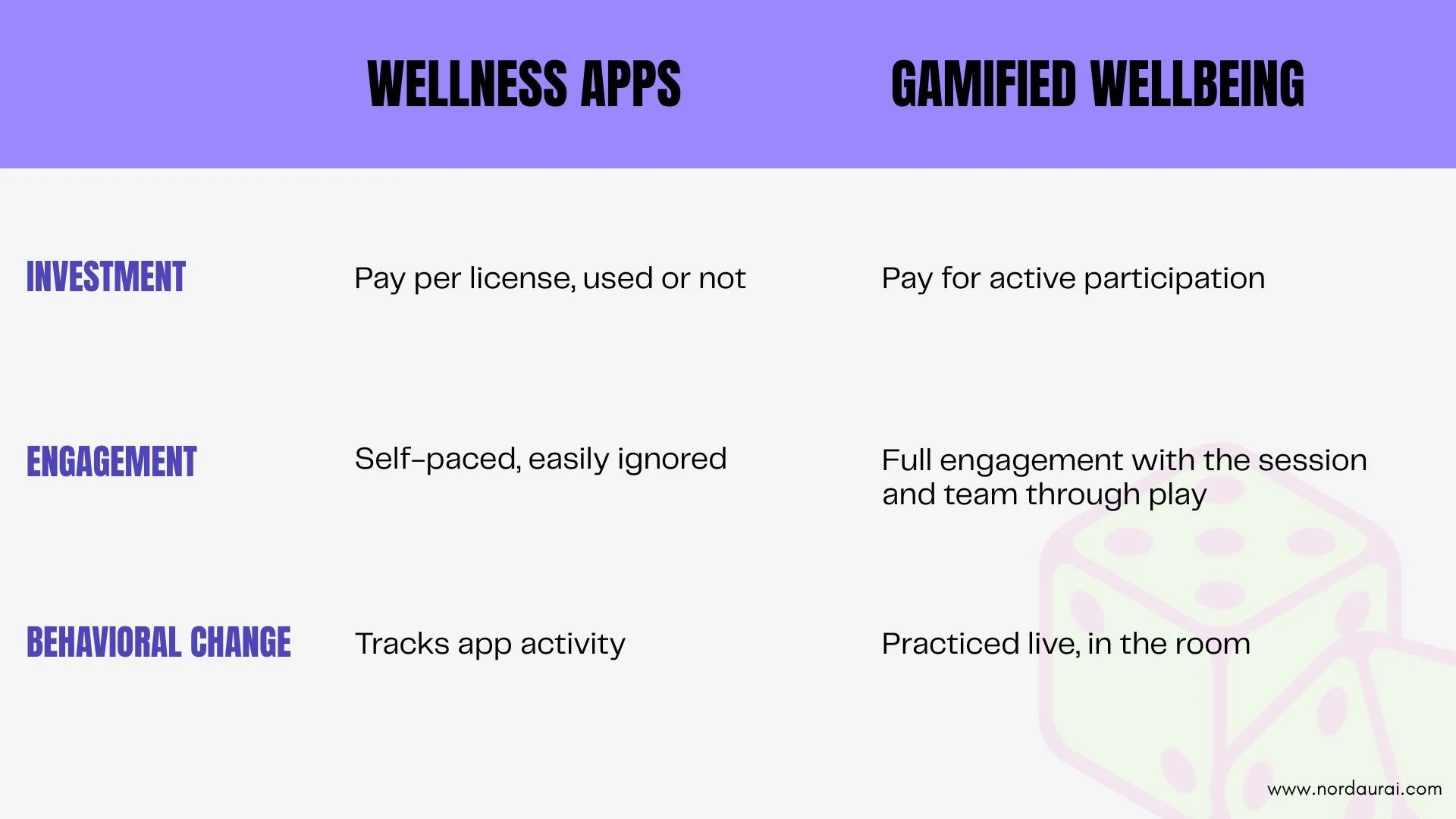
To make the difference clear, here's a comparison between subscription-based wellbeing apps and gamified wellbeing:
Investment
Wellness apps and subscriptions are priced per employee, per month, whether anyone opens the app or not. You pay for access, not outcomes. If 65 percent of your team never logs in, you're still paying for 100 percent of them.
Gamified wellbeing programs are built around active sessions, not passive licenses. Investment goes toward a program people actually show up to and play, not a subscription sitting unused in the background. The data is real and raw, not AI-generated, and not human-generated out of nowhere, there is real data behind wellbeing profiles and behavior change.
Engagement
Wellness apps rely on the employee to self-start. A push notification, a reminder email, a self-paced module, most go ignored. This is why companies end up generating their own user reports, because real usage isn't there. This also means there's no real engagement with themselves or with colleagues, it's broken.
Gamified wellbeing flips this. Engagement is the core, it's built into the format. A game requires participation by design. Nobody plays a wellbeing board game or digital wellbeing game alone in the background while checking Slack. It doesn't just create engagement, it creates fun, and players are asked to engage with themselves and with the whole team.
Behavioral Change
Wellness apps measure activity: logins, clicks, minutes spent in an app. None of that guarantees a real shift in how someone manages stress, sets boundaries, or works with their team. Most only collect surveys.
Gamified wellbeing is built on behavior change through real practice, not information. As our logo symbolizes, our approach moves through thinking, reflecting, feeling, experiencing, and changing behavior. Games like Basketball for Compassion have players take action, practice self-compassion, and then practice controlling their response based on the outcome. Tower of Emotion is another hands-on game that targets emotion management, combining physical activity, reflection, psychological action, and stress triggers, all in one game, in the room, with the team, so the change happens through doing it, not reading about it.
If your current wellbeing investment can't show you real engagement, it can't show you real behavior change either. That's the gap Nordaurai was built to close.